
Sudan: 59 years of a state without an identity
Sudan: 59 years of a state without an identity
Sudan's independence nearly six decades ago has brought few benefits for the people. Economic mismanagement, corruption, and division, shows that Sudan cannot continue on its current path for another 60 years.
6 min read
31 Dec, 2014
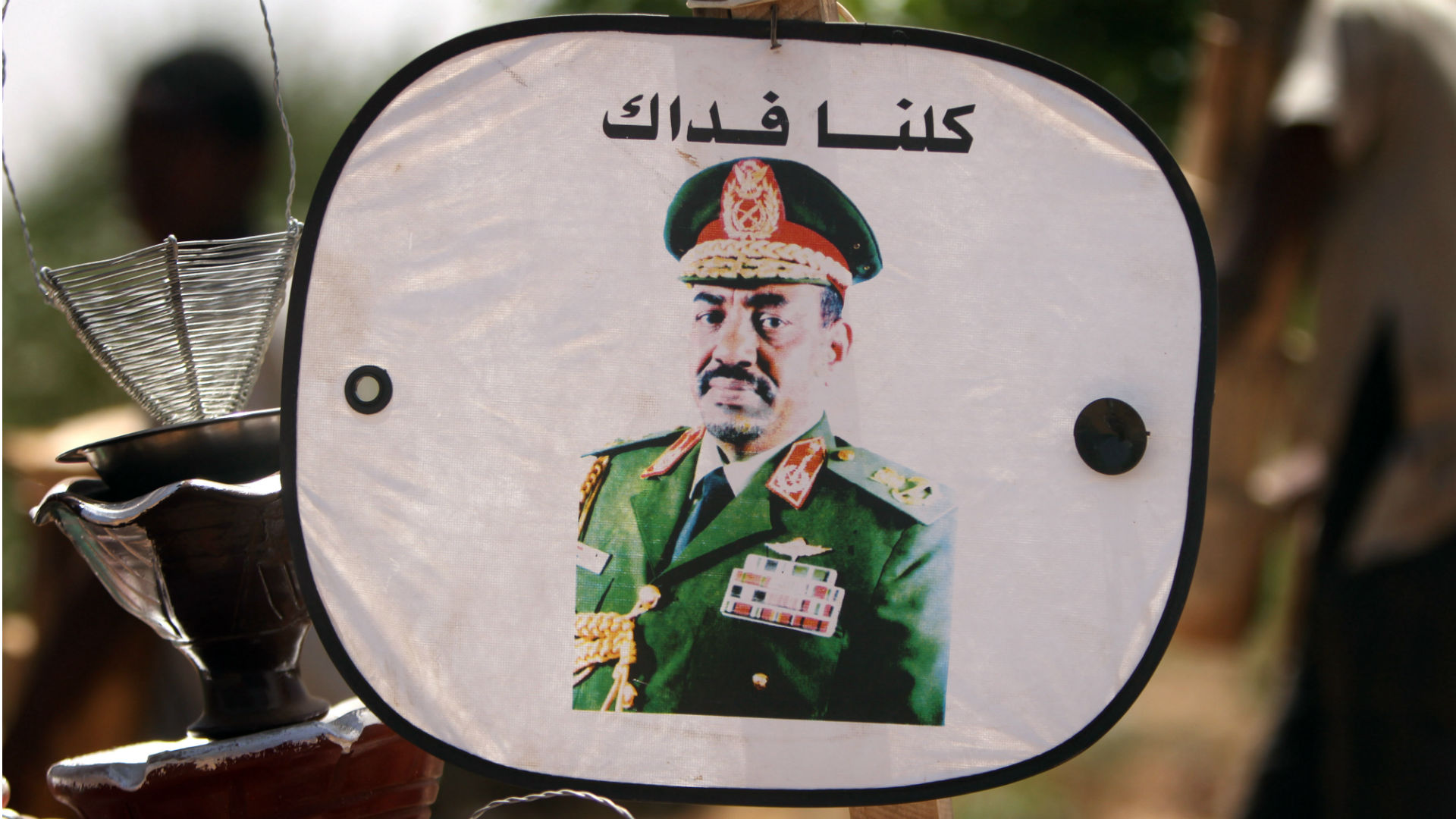
Omar al-Bashir has ruled Sudan since a 1989 coup [AFP]
It is 59 years since Sudan won its independence. It is 59 years since the flag of joint British-Egyptian rule was lowered, and the new flag of Sudan hoisted.
There is probably no better time to reflect and see what the Sudanese state has achieved since independence. Sadly, there have been few achievements to boast about.
Divided and ignored
The state that was handed over almost six decades ago no longer exists, after the secession of South Sudan in 2011. What was historically a million-square-miles territory has now been divided into a number of cantons. It is now not possible to boast about Sudan being the largest country in Africa. Sudan has been broken up, and what remains cannot be preserved forever.
For an outside observer of the country, it appears that it is Sudan's politicians who have failed to resolve the state's persistent crises. In his national dialogue address to Sudan's political leaders back in January, President Omar al-Bashir announced the areas of focus for the nation; identity, peace, freedom and the economy.
Forming a Sudanese national identity is still an ongoing process, and no easy task with competing African, Sudanese and Arab notions of self. But tackling the issue of national identity sets us on an essential path to understanding the country, its many crises, and possible solutions to Sudan's mounting problems.
First, it appears that the country's politicians and elite appear to be completely unaware of their role in this task. Their main concerns remain personal - how to seize power over the country, not for the sake of state reform or the welfare of the people, but for their own gain. As with many underdeveloped countries, power in government usually opens the gates wide open for private profit. It also leads to the suppression of the country's multi-ethnic, multi-cultural search for a national identity, in favour of a unilateral concept of the nation to suit the needs of the people in power.
Identity crisis
Since the end of the occupation of Sudan, nearly 60 years ago, the good and patient people of Sudan have been subjected to both right and left schools of thought. They also experienced a whole range of ruling systems, from parliamentary democracy to military dictatorship, and one-party federal state rule.
Nevertheless, whatever form of government Sudan took, the political elite failed miserably to maintain cohesion inside the country's borders. Territorial divides were the inevitable consequence to a poorly run state, and the weakness and indolence of the political classes is apparent in both the north and the south.
The Sudanese of the south were granted their own state after 99 per cent of the population voted in favour of independence during a 2011 referendum. It was expected that the government of the new nation would centre their efforts on the development of the fledgling state. Instead, South Sudan saw more conflicts emerge as people and tribes fought over political titles and control of resources.
It seems that South Sudan's unity only went as far as fighting Khartoum. Although rich in oil, without the necessary finances and expertise, the poverty stricken people of South Sudan now resort to rudimentary ways to survive, such as gathering fruit and sustenance farming.
Hopes fade
In the north, the situation also began to turn for the worse when South Sudan broke away from Khartoum. The economy fell apart as the previously shared oil revenues went to Juba, and were were no longer present in the state's budget. Oil once constituted 80 per cent of Khartoum's budget.
There is probably no better time to reflect and see what the Sudanese state has achieved since independence. Sadly, there have been few achievements to boast about.
Divided and ignored
The state that was handed over almost six decades ago no longer exists, after the secession of South Sudan in 2011. What was historically a million-square-miles territory has now been divided into a number of cantons. It is now not possible to boast about Sudan being the largest country in Africa. Sudan has been broken up, and what remains cannot be preserved forever.
For an outside observer of the country, it appears that it is Sudan's politicians who have failed to resolve the state's persistent crises. In his national dialogue address to Sudan's political leaders back in January, President Omar al-Bashir announced the areas of focus for the nation; identity, peace, freedom and the economy.
Forming a Sudanese national identity is still an ongoing process, and no easy task with competing African, Sudanese and Arab notions of self. But tackling the issue of national identity sets us on an essential path to understanding the country, its many crises, and possible solutions to Sudan's mounting problems.
First, it appears that the country's politicians and elite appear to be completely unaware of their role in this task. Their main concerns remain personal - how to seize power over the country, not for the sake of state reform or the welfare of the people, but for their own gain. As with many underdeveloped countries, power in government usually opens the gates wide open for private profit. It also leads to the suppression of the country's multi-ethnic, multi-cultural search for a national identity, in favour of a unilateral concept of the nation to suit the needs of the people in power.
Identity crisis
Since the end of the occupation of Sudan, nearly 60 years ago, the good and patient people of Sudan have been subjected to both right and left schools of thought. They also experienced a whole range of ruling systems, from parliamentary democracy to military dictatorship, and one-party federal state rule.
Nevertheless, whatever form of government Sudan took, the political elite failed miserably to maintain cohesion inside the country's borders. Territorial divides were the inevitable consequence to a poorly run state, and the weakness and indolence of the political classes is apparent in both the north and the south.
The Sudanese of the south were granted their own state after 99 per cent of the population voted in favour of independence during a 2011 referendum. It was expected that the government of the new nation would centre their efforts on the development of the fledgling state. Instead, South Sudan saw more conflicts emerge as people and tribes fought over political titles and control of resources.
It seems that South Sudan's unity only went as far as fighting Khartoum. Although rich in oil, without the necessary finances and expertise, the poverty stricken people of South Sudan now resort to rudimentary ways to survive, such as gathering fruit and sustenance farming.
Hopes fade
In the north, the situation also began to turn for the worse when South Sudan broke away from Khartoum. The economy fell apart as the previously shared oil revenues went to Juba, and were were no longer present in the state's budget. Oil once constituted 80 per cent of Khartoum's budget.
 |
The devastation of the nation's economy could have been avoided. |
The devastation of the nation's economy could have been avoided if the country's oil, industries and agriculture were managed better. Revenues generated from oil during the period of unity were instead spent on the further empowerment and security of the ruling party and on tightening their control over the people.
With this, politics in Sudan has been corroded. Sudan is now overcome with a fragmented political system, and as a consequence, as an entity and a state. Political parties in Darfur, such as the Justice and Equality Movement (JEM) and Sudan Liberation Movement (SLM), have been calling for the right of self-determination for all of Sudan's provinces.
Furthermore, the banned militant political movement, the Sudan People's Liberation Movement-North (SPLM-N), continues to battle the central government in its search for self-determination of Darfur, the Blue Nile and South Kordofan regions. The SPLM-N was once affiliated with the Sudan People's Liberation Movement (SPLM) in South Sudan, but broke away from them after the independence of South Sudan and continued its anti-government activities in the north.
The 2005 Comprehensive Peace Agreement between the SPLM and central government was supposed to resolve the conflict between two of Sudan's largest provinces and bring an end to a brutal civil war that had run for decades. However, a number of territorial disputes related to the crisis have yet to be resolved.
After South Sudan's independence, the SPLM-N signed a number of agreements with the government of Sudan and had, more recently, agreed to a ceasefire and negotiations with Khartoum.
The most notable of these agreements was the Framework Agreement, better known in Sudan as the Agar-Nafie Agreement, which was signed on 28 June 2011 by Malik Agar, SPLM-N chairman, and Nafie Ali Nafie, adviser to President Bashir. Just a few days later, the agreement was denounced by Bashir.
And so the ongoing conflicts have no end in sight, particularly after the last round of negotiations between the SPLM-N and the Sudan government collapsed in February 2014.
Breakup of a nation
The Republic of Sudan, the state in the north, is the next candidate for territorial division. On one hand, the opposition have lost their creative edge and the ability to present themselves as a viable alternative to Bashir's rule. On the other, the ruling National Congress Party (NCP) have completely lost their ability or desire to introduce desperately needed reforms.
Sudan is governed by never-ending layers of lethargic bureaucracy, and politicians are delusional in their belief that the country can be run with state elections that have no competition. For them, it is as if Sudan's disastrous state of affairs are occurring in a mythical land, or a separate parallel reality.
It is clear that Sudan has been slowly collapsing as a state. The political situation is fragile and the political parties are weak, completely incapable of finding creative solutions to Sudan's mounting and increasingly complicated challenges. The Sudanese people are the victims and have revolted against the status quo twice.
With no development to the welfare system, the situation for the people is getting worse, and their wealth continues to be looted by corrupt bureaucrats.
Sudan has utterly failed to manage its multi-ethnic and religious differences after South Sudan left to walk its own path. This diversity - which could be one Sudan's greatest strengths - continues to be treated as an opportunity for personal gain, and brings the country closer to complete division.
This article is an edited translation to our Arabic edition.
Opinions expressed in this article remain those of the author and do not necessarily reflect the opinions of al-Araby al-Jadeed, its editorial board or staff.
More in Opinion


