
Lebanese journalist interviews Hizballah 'prisoners' held by Nusra Front
Lebanese journalist interviews Hizballah 'prisoners' held by Nusra Front
In the first video of its kind to emerge since the start of the Syrian war, Lebanese journalist Carol Malouf purportedly interviewed Hizballah captives held by Syria's al-Qaeda franchise.
3 min read
08 Feb, 2016
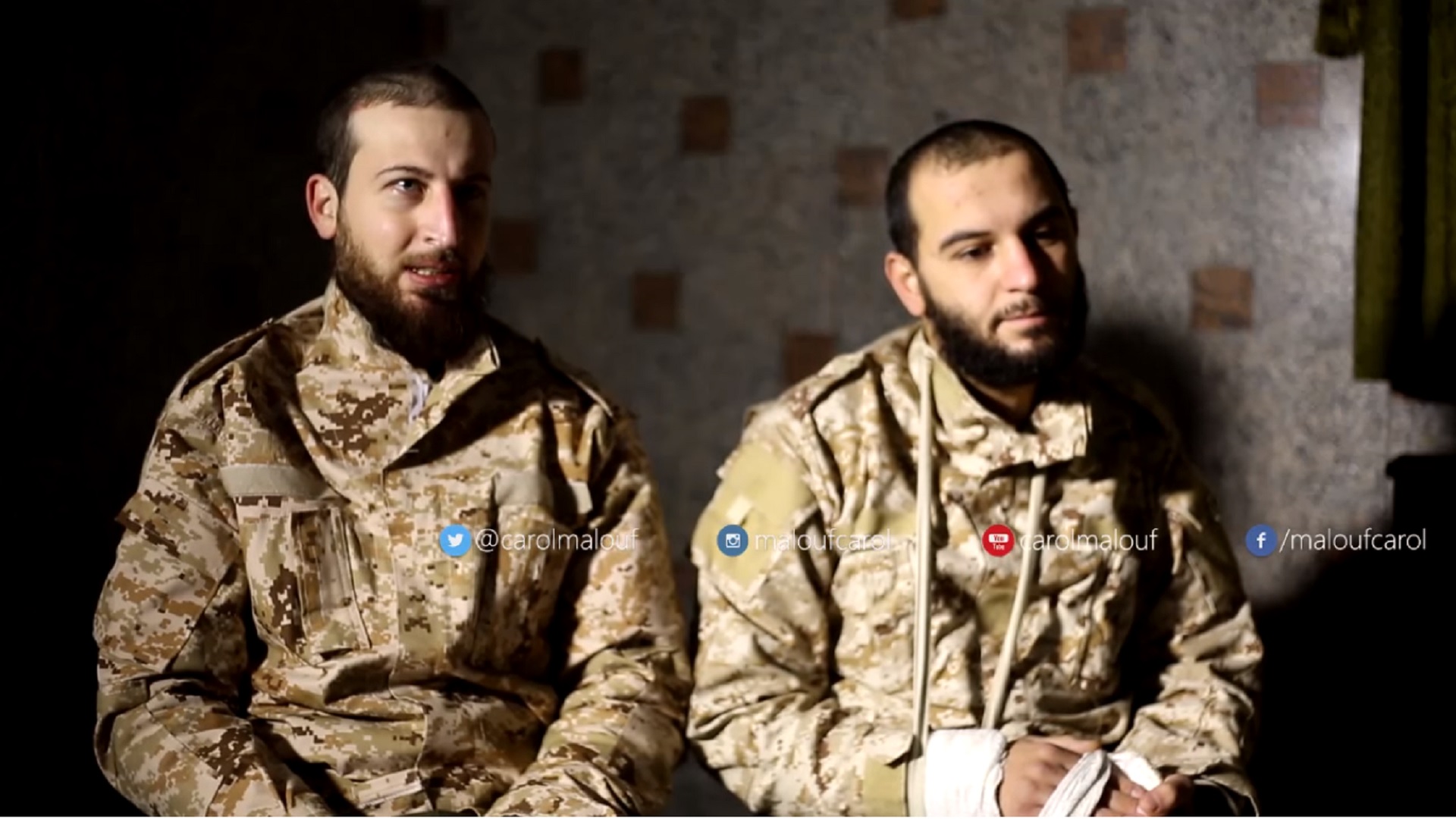
Screen grab from the interview video [YouTube]
Last December, Lebanese journalist Carol Malouf travelled to Syria, into areas controlled by the local al-Qaeda affiliate, the Nusra Front.
There she met two alleged members of Hizballah who had reportedly been held captive by Nusra for 42 days, they said during the interview.
The video was posted this week on YouTube, and The New Arab cannot vouch for the authenticity of its contents, but two of the men identified themselves to Malouf as Hassan Nazih Taha and Mohammad Mahdi Shoaib.
They said they were captured in the southern Aleppo countryside along with a third Hizballah member, Musa Mohammad Kourani, who was injured in the Nusra Front ambush.
The purported Hizballah "prisoners of war" said they were technicians with little to no weapons training, and had been asked to deploy to the area to install communications equipment.
Taha and Shoaib, answering a question from Malouf, claimed that despite initially thinking they would be beheaded for being Shia Muslims, their jihadi captors treated them well.
They did not torture them and tended to their bullet wounds sustained in the ambush, though they said they were initially beaten.
During 58-minute interview, the Lebanese journalist, who had previously been given access by the Nusra Front to interview Lebanese soldiers held in the group's custody for more than a year, pressed the men to reveal their loyalties and motives for joining Hizballah.
There she met two alleged members of Hizballah who had reportedly been held captive by Nusra for 42 days, they said during the interview.
The video was posted this week on YouTube, and The New Arab cannot vouch for the authenticity of its contents, but two of the men identified themselves to Malouf as Hassan Nazih Taha and Mohammad Mahdi Shoaib.
They said they were captured in the southern Aleppo countryside along with a third Hizballah member, Musa Mohammad Kourani, who was injured in the Nusra Front ambush.
The purported Hizballah "prisoners of war" said they were technicians with little to no weapons training, and had been asked to deploy to the area to install communications equipment.
Taha and Shoaib, answering a question from Malouf, claimed that despite initially thinking they would be beheaded for being Shia Muslims, their jihadi captors treated them well.
They did not torture them and tended to their bullet wounds sustained in the ambush, though they said they were initially beaten.
During 58-minute interview, the Lebanese journalist, who had previously been given access by the Nusra Front to interview Lebanese soldiers held in the group's custody for more than a year, pressed the men to reveal their loyalties and motives for joining Hizballah.
 |
The Hizballah prisoners insisted they were telling the truth about being treated well, but former hostages have often reversed such statements after their release |  |
Taha and Shoaib revealed some details about Hizballah's recruitment, indoctrination, training and mobilisation methods. They said they were enticed to join because of the extensive salaries and benefits the group offers its members.
However, they also expressed regret for being in Syria, calling Hizballah "an invader" that had no business intervening in the country's war.
They also held Hizballah responsible for their capture, saying they were sent to an area that was supposed to be secure without armed escorts.
The pair told the interviewer they encountered many Iranian, Iraqi and even Afghan Shia fighters, claiming the Syrian army's role was mostly for PR and support.
The Nusra Front is designated by the United States and several other countries as a terrorist organisation.
It abducted Lebanese army soldiers in the summer of 2014 during a cross-border raid of the Arsal region, and held them hostage for more than a year until they were swapped for Islamist-linked detainees late last year.
The Nusra Front is excluded from peace talks - though there have been calls for it to be rehabilitated and brought in from the cold if it cuts links to al-Qaeda.
Malouf, who was sporting a headscarf in the interview despite being Christian, often defends the jihadi group as a homegrown Syrian faction, despite its links to al-Qaeda.
The alleged Hizballah prisoners of war claimed to Malouf most of the Nusra members they encountered were Syrians, and not foreign fighters, as they had been led to believe before coming to Syria.
On social media, some were quick to dismiss the video as al-Qaeda propaganda.
They said that the prisoners were speaking under duress, while others praised Malouf for her efforts in "uncovering the truth".
Hizballah, which fought Israeli occupation in Lebanon for decades, intervened in the Syrian civil war alongside the regime in Damascus.
The group claimed the war is pre-emptive "holy defensive" battle against jihadis, to prevent them from threatening Lebanon and "the resistance" against Israel.
However, the opponents of the Syrian regime say Hizballah's intervention is part of Iran's campaign to prevent the fall of its ally, Bashar al-Assad.

![President Pezeshkian has denounced Israel's attacks on Lebanon [Getty]](/sites/default/files/styles/image_684x385/public/2173482924.jpeg?h=a5f2f23a&itok=q3evVtko)


 Follow the Middle East's top stories in English at The New Arab on Google News
More in Opinion

07 November, 2024

06 November, 2024
