
Ahed Tamimi, an inconvenient hero
Ahed Tamimi, an inconvenient hero
Comment: Ahed Tamimi’s arrest isn't unique; she's one of many children detained in prison, but the lacklustre response from the West is telling, writes Amal Awad.
8 min read
03 Jan, 2018
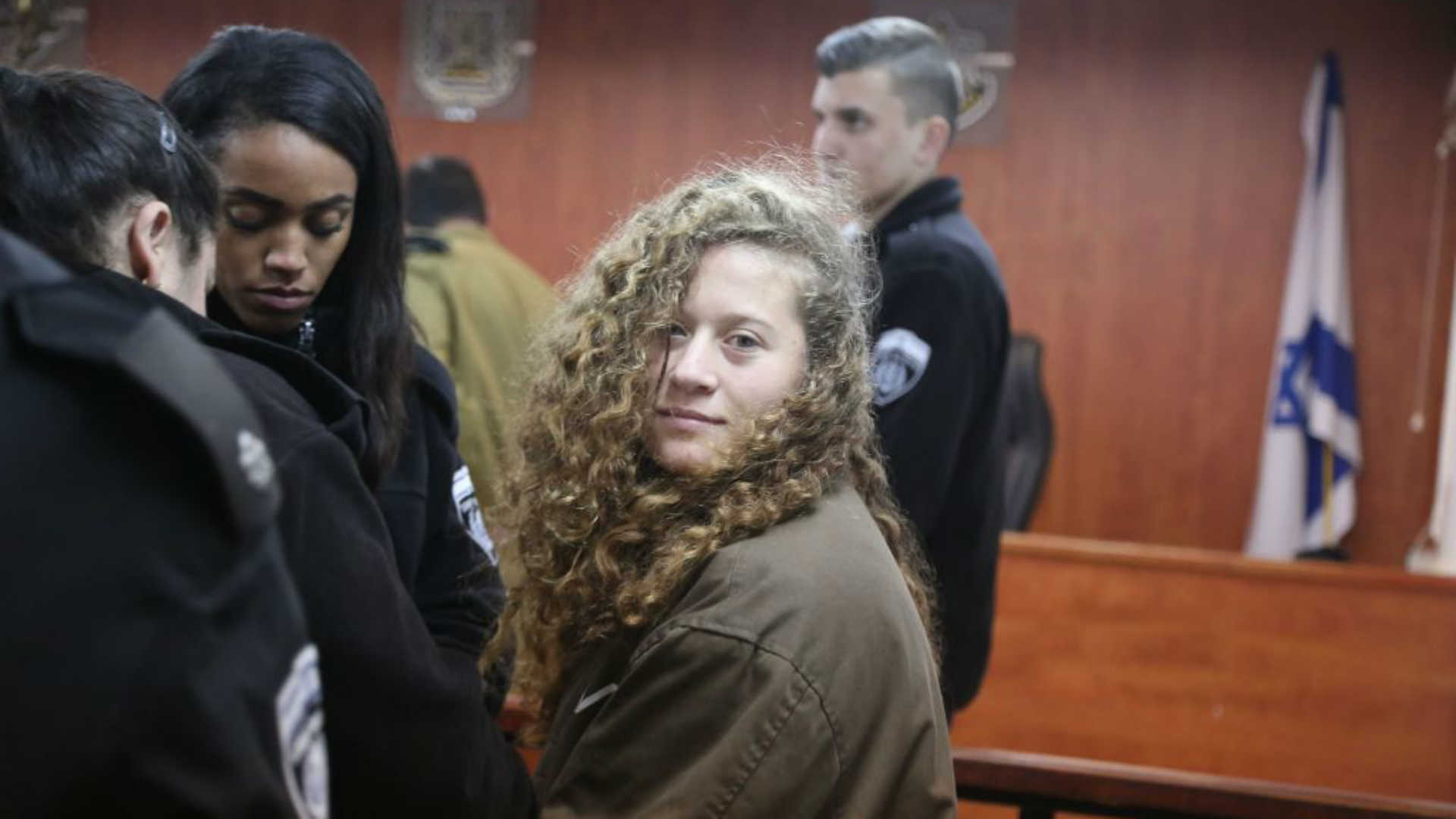
Ahed Tamimi appears in court after she was taken into custody by Israeli soldiers [Anadolu]
It was few years ago now that Australian current affairs programme Four Corners aired a devastating piece on Palestinian children in detention.
In it, you see Israeli soldiers deploying tear gas as children make their way to school. It showed children being arrested and bundled into military vans.
Regardless of the many international laws dictating humane treatment of children, Israel is a nation unto itself, flouting international regulations at every turn. Its greatest concern is not its morality, but rather preserving the mask of it.
Because Israel as a democratic, fair-minded state is an illusion.
It perpetuates and trades on a pervasive sense of victimhood, knowing that lobbing accusations of anti-Semitism at critics will help to silence them.
Nowhere is this more obvious than in the global response to the arrest of Ahed Tamimi, a 16-year-old resistance wunderkind, rebellious, fierce, with striking blonde, unruly hair.
She makes headlines, and this isn't the first time - it wasn't long ago that she went after a soldier harming her young brother, who was nursing an already-injured arm. This time, she and her family say her actions were in response to a family member being shot in the face with a rubber bullet. For her trouble, she was arrested, as were her cousin and mother.
That Ahed is angry is evident; but what is more awe-inspiring is how genuinely fearless she appears. She fronted up to a soldier and slapped him. In cuffs in court, she smiles, her look knowing, the justice system a farce.
 |
This puts on full display how disingenuous lefties can be when they cherry-pick their champions |  |
At an event in South Africa to raise awareness about life in her village, Nabi Saleh, which is surrounded by illegal settlements, she took in the emotional, teary response.
Displaying emotional intelligence and a sharpness of mind that belies her years, Ahed recognised that she risked being a convenient and short-lived emblem of hope. She urged the audience to shift their perspective.
"I don't want to be perceived as a victim, and I won't give their actions the power to define who I am and what I'll be. I choose to decide for myself how you will see me. We don't want you to support us because of some photogenic tears, but because we chose the struggle and our struggle is just. This is the only way that we'll be able to stop crying one day."
Yet, she needn't have worried. The silence from the West, especially its extremely vocal feminist movements, is notable. Not even reports that she has been beaten, and the fact of her prolonged imprisonment for slapping a soldier, has put a charge in people's responses.
Twitter Post
|
This puts on full display how disingenuous lefties can be when they cherry-pick their champions. Malala Yousafvai was deservedly commended for her bravery in demanding an education.
Her cause is one that's easily relatable, and consequently, world interest in her rose - she was lavished with praise, awards, a documentary, a book and speaking engagements around the world. She's consistently propped up as a hero to westerners, and her looks help - she is identifiably Muslim; she's "the other" making good, wanting to be like westerners.
This is not to detract from Malala's achievements. She's important. But she's also part of a trend, to highlight injustice when there's a directly relatable link, and where it's an obvious display of solidarity. Supporting Malala, the poor schoolgirl in a headscarf, is arguably a charitable act that does more for the person posting praise than females in Afghanistan.
And take, for example, all the commentary from western feminists on Saudi Arabia. I can't tell you how many times I've been "schooled", how many times women have talked about how disgusted they are with Saudi Arabia's inequitable treatment of women, as though they have knowledge and understanding Arab women themselves lack.
They are not interested in working with Arab women; they feel sorry for them and find commonality - not being able to drive? That would hurt, and so they find their voice to criticise and show "solidarity".
Yet, all of these solidarity threads dissolve when it comes to Palestine. There are many notable supporters of Palestinians - they see the need for justice, for a fairer representation of what life is like under occupation.
Left-wing media can do a decent job of piercing through Israel's hasbara (propaganda), though the challenge there is to present facts without over-compensating in order to reach the cynical.
But where is the consistently trending hashtag for Ahed? For all she represents? Where is the outrage? Where is the disgust at Israel's consistently flagrant abuses of law?
|
But where is the consistently trending hashtag for Ahed? For all she represents? Where is the outrage? | |
They don't follow because, like Israel's mask of morality, genuine support is flimsy. Resistance is poetic and beautiful in a fictional world, but in the real one, allegiance is complex.
People aren't so quick to criticise when there's no direct connection to them, or where it's not easy to do so - it's not just a nod with Palestine; you risk being accused of racism.
Israel frequently stifles any form of criticism by attacking dissent as anti-Semitism. Take Lorde, a pop star who chose to reconsider her appearance in Tel Aviv. She delivered a clear response. She was subsequently called a bigot in a major US newspaper.
Read more: Palestine. It's about injustice, not religion
And the imagination is in overdrive. Haaretz columnist Gideon Levy disbelievingly asks how Israelis have lost their humanity, to not be moved by Ahed's plight.
He riffs on her looks - she could just as easily pass for Israeli with her blonde hair and pale skin. And still, you're not moved? Well, no, because she's not Israeli, she's a Palestinian. "Tamimi is a Palestinian, that is to say, a terrorist, and therefore, she doesn't deserve any feelings of sympathy. Nothing will crack the defensive shield that protects Israelis from feelings of guilt, or at least discomfort, over her outrageous arrest, over the discrimination by the justice system, which would never have paid any attention to her had she been a Jewish settler."
When I met with Salwa Duaibis, co-founder of the organisation Military Court Watch last year for my research on Arab women, she revealed that incarceration of children is a form of intimidation that works to keep children indoors. Too afraid to leave their houses, they are stripped of ordinary lives.
Twitter Post
|
It doesn't radicalise them. It dilutes their spirit and stifles their development. "To radicalise someone is to kill someone's relative. That's the only time a person becomes radical," Salwa said.
Ahed's incarceration and her heroism are inconvenient.
For all of the joy people take in championing strong female characters in dystopian fiction and film, the real world is too much. Ahed, a vision of youth and hope, is scaring people because she's difficult to ignore.
She is making headlines, unlike the countless other children who have been arrested in the dead of night and tortured into confessions.
The majority of those arrested are boys, and as Salwa Dubais told me, "The quickest way out of the system is to plead guilty, so even if that boy didn't do anything wrong, he will be advised by his parents and by his lawyer to plead guilty because that's the quickest way to get out of prison."
Ahed's prospects for justice are slim. Children arrested are often put away, and with a bullish US withdrawing even its nominal support of Palestinians, they will continue to answer to no one. The US, that "champion of freedom", will side with the oppressor. And other countries will either remain silent observers, or be ignored.
Israel holds utter contempt for Palestinians and their rights as humans, capitalising on the sensitivities of criticising a state whose people have their own troubled history.
|
Supporting Malala, the poor schoolgirl in a headscarf, is arguably a charitable act that does more for the person posting praise than females in Afghanistan | |
And this is part of the problem; the roadblock so many face when trying to discuss the occupation of Palestine. Critics, no matter how fair-minded and reasonable, will always be met with the emotion of the Israeli's right to live in peace.
The gross hypocrisy of Israel is on full display. It accommodates Syrian refugees in its hospitals even as it incarcerates, demonises and kills Palestinians.
Yet Israel continues the familiar narrative of being the victim of the occupation its forced to inflict on people who seek to harm them. This is the overriding narrative, the juice of Israel's hasbara machine.
It is meeting the challenge of a social media saturated world by trying to stifle voices, a recent report stating that Facebook is deleting the accounts of Palestinian activists under direction from Israel and the US.
As Israel consistently declares itself a nation under threat, it seems completely and inexplicably blind to its own desire to eradicate that niggling issue of Palestinians. Israel, against all international regulation, literally bulldozes people's homes. It encroaches on their land to build settlements, and seizes natural resources belonging to land owners who rely on them not simply for sustenance, but also their harvests.
As humans we embrace tribalism and subscribe to the hero's journey. We love our heroes and heroines. Ahed is an inconvenient one.
Amal Awad is a Sydney-based journalist and author. Her latest book, Beyond Veiled Clichés, explores the lives of Arab women.
Follow her on Twitter: @amalmawad
Opinions expressed in this article remain those of the author, and do not necessarily represent those of The New Arab, its editorial board or staff.
More in Opinion


