 English
 French
 Spanish
 German
 Italian

Yemen forces vow to retake Sanaa in major offensive against Houthis
Yemen's government-aligned forces have launched a multi-front offensive against the Houthis, vowing to retake the capital Sanaa.
The Houthis and Yemen government forces have engaged in tit-for-tat strikes [Getty]
Yemen's government-aligned forces have launched a multi-front counteroffensive against the Houthis, declaring the recapture of Sanaa as their ultimate objective amid a major escalation in fighting across the country.
Forces aligned with Yemen's internationally recognised government reported advances in al-Jawf, al-Bayda, Taiz and Hodeida on Monday, days after the Houthis launched an offensive towards the strategically important Bab al-Mandab Strait.
Major-General Samir al-Sabri, Yemen's deputy defence minister, told state television that a decision had been made to "retake Sanaa", which has been under Houthi control since 2014.
Majid al-Nuzaili, a spokesman for Yemen's government-aligned forces, similarly said the objective was to "liberate Yemen" from Houthi control and restore Sanaa as the country's capital.
Al-Nuzaili also warned civilians to stay away from several major routes towards Sanaa, including roads through Nihm, Sirwah, Mahliyah and al-Hazm connecting the capital with Marib and al-Jawf.
The declarations do not, however, mean government forces are close to entering Sanaa, with heavy fighting continuing across several fronts and both sides making competing claims about battlefield gains.
Rashad al-Alimi, chairman of Yemen's Presidential Leadership Council, said government forces had made gains in al-Jawf, al-Bayda, Taiz and Hodeida, claiming they had regained the initiative against the Houthis.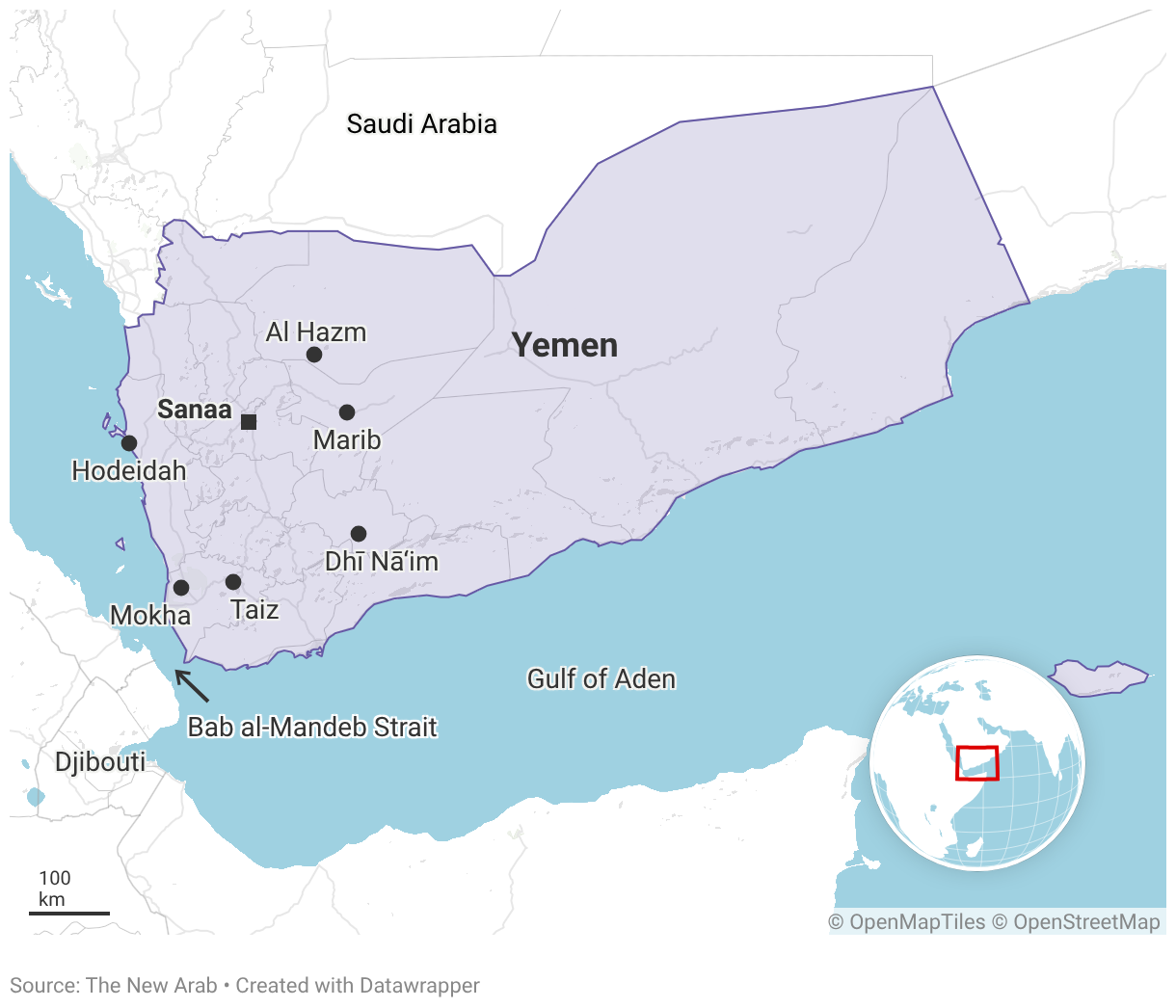
The government-aligned Giants Brigades said they had captured strategic positions in al-Bayda, while the Yemeni military reported carrying out 13 air strikes against Houthi positions, vehicles and gatherings in the governorate.
Government forces also reported reaching the outskirts of Dhi Na'im in al-Bayda and conducting operations around Yatma in al-Jawf.
The Houthis disputed government accounts of the fighting, saying they had repelled an advance towards the al-Labanat mountains in al-Jawf and inflicted casualties on government-aligned forces.
Neither side's battlefield claims could be independently verified.
The counteroffensive follows a major Houthi operation launched last week through western Taiz and southern Hodeida towards the port city of al-Makha and the Bab al-Mandab Strait.
The narrow waterway connecting the Red Sea with the Gulf of Aden is one of the world's most important shipping routes and has become increasingly significant amid wider regional disruption to maritime trade.
The fighting has since expanded into al-Dhalea, Marib, al-Jawf and al-Bayda, suggesting government forces are attempting to stretch Houthi forces by opening several fronts simultaneously.
The escalation has also spilled directly into neighbouring Saudi Arabia, which backs Yemeni government forces and has led a military coalition against the Houthis since intervening in Yemen's war in 2015, leading to one of the worst humanitarian crises in the world.
Houthi missile and drone attacks on Tuesday targeted civil infrastructure and economic sites in the southern Saudi cities of Abha, Khamis Mushait, Jizan and Najran, according to the Saudi-led coalition.
Saudi authorities said 73 civilians, including women and children, were wounded in the attacks.
Saudi Arabia's energy ministry said fires broke out at several energy facilities and utilities following the strikes, forcing operations at some sites to be temporarily suspended.
The Houthis said they had targeted Saudi Aramco facilities and King Khalid Air Base, describing the operation as retaliation for Saudi strikes on Yemen.
The renewed fighting is also taking a growing humanitarian toll.
The World Health Organization said on Monday that nearly 900 people had been killed or wounded since Thursday, with most casualties recorded in Taiz and along Yemen's western coast.
Around 21,000 people, equivalent to roughly 3,000 families, have also been displaced from Taiz, according to the WHO.
UN Special Envoy for Yemen Hans Grundberg described the escalation as "extremely alarming" on Monday, warning that a return to sustained large-scale fighting would have grave consequences for civilians and further undermine efforts to reach a political settlement.
Yemen had experienced a relative reduction in large-scale fighting since a UN-brokered truce took effect in April 2022, although a comprehensive peace agreement was never reached.

Related Articles


