 English
 French
 Spanish
 German
 Italian
Algeria cuts ties with UAE over 'hostile actions, Abu Dhabi hopes measure is 'temporary'
Algeria has severed diplomatic ties with the UAE over alleged "hostile" actions, a decision which Abu Dhabi said it hoped would be temporary.
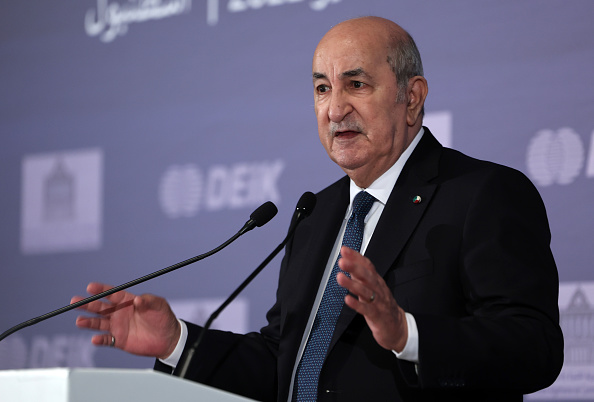
Abdelmadjid Tebboune has repeatedly accused the UAE of interfering in Algeria's affairs and destabilising countries across the region. [Getty]
Algeria has cut diplomatic relations with the United Arab Emirates following years of mounting tensions, accusing Abu Dhabi of increasingly "provocative or hostile" actions despite repeated warnings from Algiers.
The Algerian foreign ministry announced the decision on Thursday, saying the government had "exhausted all means" of preserving bilateral relations with the Gulf state. The UAE ambassador was summoned to the foreign ministry in Algiers and formally informed of the decision, and given 48 hours to comply with the measure.
"Faced with the increasing provocative or hostile actions emanating from the United Arab Emirates, Algeria has exercised a great deal of restraint and a high sense of responsibility," Algeria's foreign ministry said.
It said Algiers had repeatedly drawn the Emirati side's attention to its concerns and warned it of the "serious consequences" that could result from what it described as "regrettable and unjustified behaviour".
"Despite these numerous warnings, the United Arab Emirates continued to persist in these actions, which have reached limits where they can no longer be considered acceptable or tolerable within the framework of relations between two sovereign states, nor remain without a response," the statement added.
The ministry did not specify which actions had directly triggered Thursday's decision, but relations between Algeria and the UAE have deteriorated considerably in recent years amid disagreements over regional affairs and repeated Algerian accusations of Emirati interference.
The UAE said it hoped Algeria's decision would be temporary.
"In light of the decision by the People's Democratic Republic of Algeria to sever relations with the United Arab Emirates, the UAE expresses hope that this decision will be temporary, in a manner that preserves the fraternal ties between the two brotherly peoples," the Emirati foreign ministry said on X.
Separately, diplomatic adviser to UAE President Mohammed bin Zayed, Anwar Gargash, appeared to hit back at Algiers, saying diplomatic relations should be managed through "reason, communication and clarity of interests", rather than "riddles and signals that need decoding".
"Relations cannot be hostage to internal tensions or an inability to explain interests and define priorities," Gargash wrote on X. "Ambiguity is not a policy, and noise does not compensate for the absence of vision."
Thursday's decision makes the UAE the second Arab country with which Algeria has severed diplomatic relations, after it cut ties with Morocco in August 2021.
Years of mounting tensions
Algerian President Abdelmadjid Tebboune has repeatedly criticised the UAE without always naming it directly, accusing the Gulf state of attempting to interfere in Algeria's internal affairs and destabilise countries across the region.
In a televised interview in July, Tebboune referred to the UAE as a "micro-state" and accused it of having a "very negative impact" wherever it became involved.
"Wherever they set foot, blood flows," Tebboune said at the time. "We want them to stay away, so that blood does not flow in our country," he added.
The Algerian president also suggested at the time that relations had come close to being severed previously.
"A diplomatic break would have happened long ago," he said, explaining that Algeria had refrained from taking the step because it did not want to contribute to further divisions within the Arab world.
Tebboune has previously contrasted Algeria's relationship with the UAE with its ties to other Gulf countries, describing relations with Saudi Arabia, Qatar, Kuwait and Oman as brotherly while accusing an unnamed Gulf state, widely understood to be the UAE, of interference.
Algeria also announced that it would close its airspace to UAE-registered civilian and military aircraft, except for commercial flights to and from Algiers airport, which would continue until the end of 2026.
"Algeria has decided to close its airspace, effective September 11, 2026, at midnight, to all civil and military aircraft registered in the UAE... except for Emirati civil commercial flights to or from Algiers Houari Boumediene International Airport, which will continue until the end of 2026, when the contract expires," the Algerian defence ministry said.
The move builds on measures taken in April, when Algeria halted flights by Emirati airlines and cancelled an air services agreement between the two countries.
Economic tensions had also emerged after Algeria reviewed the status of some companies in which Emirati entities hold stakes, with Abu Dhabi threatening to resort to international arbitration over the disputes.
Regional disputes
Tensions extend beyond bilateral relations, with Algeria and the UAE frequently taking different positions on regional conflicts and political disputes.
Algeria has long emphasised the principle of non-interference in the internal affairs of other states and has maintained particularly strained relations with neighbouring Morocco, with which it severed diplomatic ties in 2021.
The Western Sahara dispute remains at the heart of the Algeria-Morocco rivalry. Algiers supports the Polisario Front and the Sahrawi right to self-determination, while Rabat claims sovereignty over the disputed territory.
The UAE's close relationship with Morocco has consequently been a source of friction with Algeria. Abu Dhabi became the first Arab country to open a consulate in Moroccan-controlled Western Sahara in 2020, in a move welcomed by Rabat.
Algerian media close to the authorities have also accused the UAE of links to the Movement for the Self-Determination of Kabylia, known by its French acronym MAK, which Algeria designated a terrorist organisation in 2021.
The allegations are particularly sensitive in Algeria, where authorities regard separatist movements as a threat to the country's territorial integrity. The UAE has denied broader accusations that it seeks to destabilise Algeria.
The two countries have also found themselves at odds over developments elsewhere in North Africa and the Sahel, where competing alliances and approaches to regional conflicts have contributed to growing distrust.
Related Articles


